A blog sponsored by the Michigan State University Museum's Michigan Traditional Arts Program, a partnership with the Michigan Council for Arts and Cultural Affairs. Sharing news and information about the Great Lakes Folk Festival, Quilt Index, the MSU Museum's traditional arts activities, Great Lakes traditional artists and arts resources, and much more. Development of content for this blog supported by funding from the National Endowment for the Arts.
Showing posts with label MSU Museum. Show all posts

Tuesday, November 24, 2015

Document Your Family Folklore This Thanksgiving


Become a folklorist this Thanksgiving holiday and document your family folklore.

Quillworker Yvonne Walker Keshick with her grandchildren at the 2015 GLFF.

Family folklore could include stories, jokes, music, rituals, games, scrapbooks, videos, recipes, and material culture. 
"For an individual family [however "family" may be defined], folklore is its creative expression of a common past. As raw experiences are transformed into family stories, expressions, and photos, they are codified in forms which can be easily recalled, retold, and enjoyed. Their drama and beauty are heightened, and the family’s past becomes accessible as it is reshaped according to its needs and desires," (Zeitlin 1982).
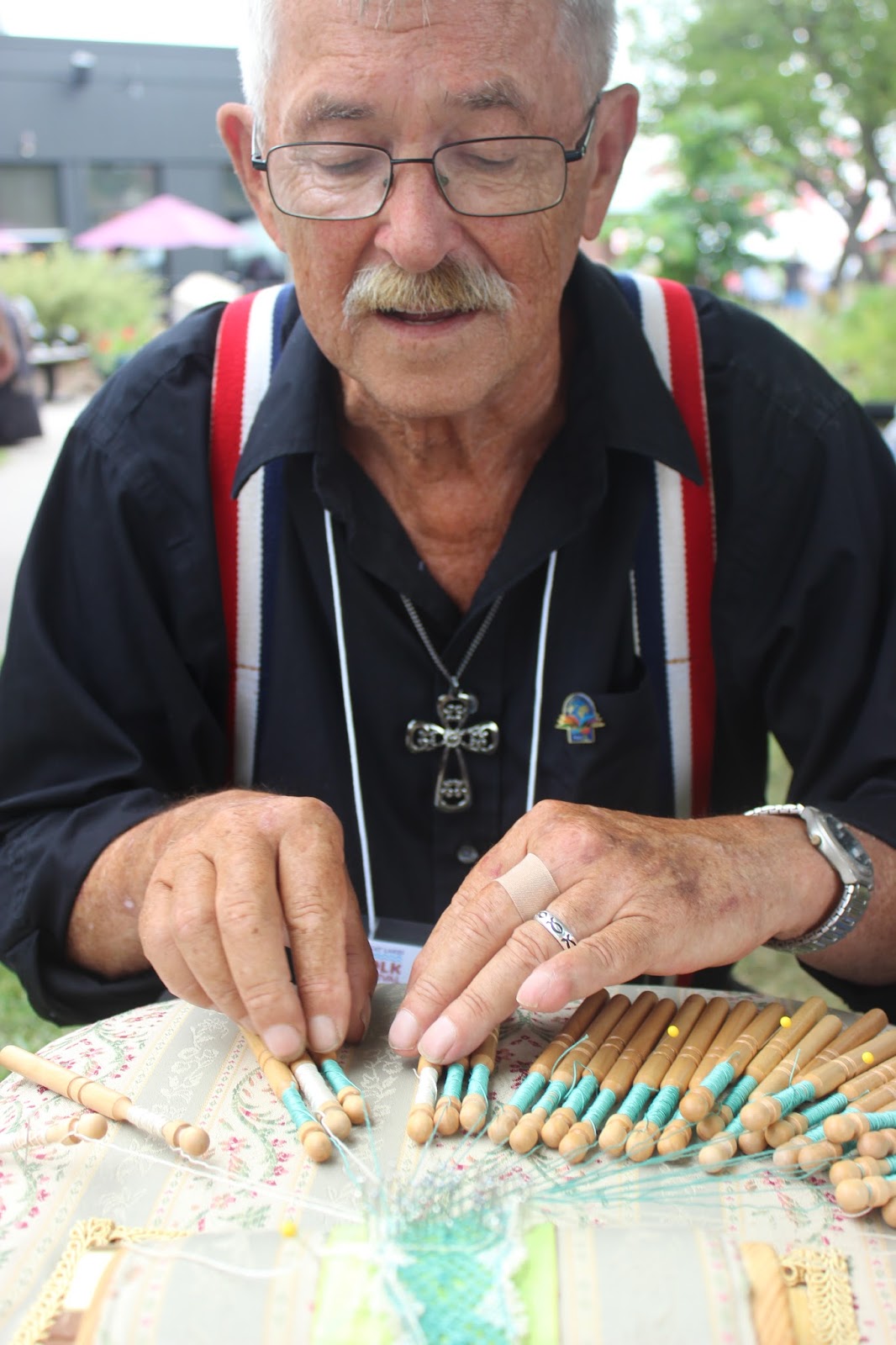
Lacemaking has been passed down for generations in Ron Ahren's family.
An easy way for anyone to document family folklore is to interview a relative through the StoryCorps app.


"The StoryCorps app—a free mobile application—seamlessly walks users through an interview by providing all the necessary tools for a wonderful experience. You will receive help preparing questions, finding the right environment for your conversation, recording a high-quality interview on your mobile device, sharing the finished product with friends and family, and uploading your conversation to the StoryCorps.me website. This site is a home for the recordings and also provides interviewing and editing resources. In addition, all interviews uploaded to the platform during the first year of the program will be archived at the American Folklife Center at the Library of Congress," (https://storycorps.me/about/).
Though the app has built-in questions to ask your interviewee, we suggest you make your own questions centering on family traditions.
 
What kinds of traditions does your family have for Thanksgiving?

Ask about Foodways
            What dishes do you always have at Thanksgiving?
            How do you make the dishes?
            Where does the recipe come from?
            Where do the raw ingredients come from?
            Who cooks what?
            What kind of cookware is used?
            Are there special serving dishes?
            When do you eat?

Ask about Music
            What kinds of music do you listen to during the holidays?
            When do you listen to music during the holidays?          
Does anyone in your family play music?
                        Where did they learn?

Ask about Stories
            What are the stories, tales, and myths told?
                        Where do they come from?
                        What kinds of stories are they? Humorous, cautionary, or romance?
            Who tells stories at a gathering?
            In what setting are stories told?
           
Use the Story Corps app to record and archive your interview.  Tag your interview with “MSU Museum” and your interview may be featured on the Great Folks blog! We want to hear about your folklife. 

If you need some pointers for interviewing, the Smithsonian has a free online guide available here.


Work Cited
Steve Zeitlin. A Celebration of American Family Folklore. Cambridge, MA: Yellow Moon Press, 1982, p. 2 

Photos by M. McBride.  

Friday, November 20, 2015

MSU Museum's MacDowell Named American Folklore Society Fellow

MacDowell at the Great Lakes Quilt Center of the MSU Museum
Michigan State University Museum Curator of Folk Arts Dr. Marsha MacDowell has been named a fellow of the American Folklore Society (AFS), demonstrating outstanding accomplishments and making important contributions to the field of folklore.

Established in 1960, the Fellows of the American Folklore Society are folklorists who have produced a significant number of important articles, books, and other scholarly productions or exhibitions on folklore, and have provided meritorious service to the Society and the discipline of folklore studies. In addition to her substantial record of publications and exhibitions, MacDowell has served in a number of capacities within AFS, including as elected member of the AFS executive board.
MacDowell is also a professor in MSU's Art, Art History, and Design Department as well as a core faculty member in the College of Arts and Letters Museum Studies Program, where she serves as the program's internship coordinator and teaches future museum professionals curatorial, research, field work, exhibition and civic engagement work. Her research interests include South African quilt history; traditions of patchwork covers in China; quilts and health; the history and meaning of lau hala in Hawaiian culture; and the intersection of ethnography and museums in a digital age. She is the director of the Quilt Index, an international digital repository of stories, images, and other data related to quilts and their makers.

MacDowell has curated over 50 research-based interpretive exhibitions and festival programs as Michigan State University and is founding director of the MSU Museum's Great Lakes Folk Festival, a university-community partnership. As the Coordinator of the Michigan Traditional Arts Program since 1984, she has led many projects focused on Michigan traditional and cultural heritage. 

Thursday, November 5, 2015

MSU Museum's Quilts of Southwest China Featured on WKAR

Bedcover, c. 1940
Photo by Pearl Yee Wong
The new exhibit at the MSU Museum, "Quilts of Southwest China," opened September 28th, and runs until April 30th, 2015. Folk Arts Curator Marsha MacDowell sat down with WKAR's Peter Whorf to discuss the exhibit.

From the WKAR website:
Dr. Marsha MacDowell was surrounded by quilts from the start. She says she was born with an instant quilt collection assembled by her quilting grandmothers. The quilts from MacDowell’s childhood bed made their way to her residence hall during student days at MSU.
Her love and knowledge of art and textiles ultimately led to a professorship in Art and Art History at Michigan State, and her role as Folk Art Curator at the MSU Museum.
Dr. MacDowell is the author of numerous books about the art of quilts in Michigan and beyond. Her most recent work with MSU’s ongoing China Experience project now connects her passion for the art to people half a world away.
Current State's Peter Whorf talks with MacDowell about the exhibition.
Listen to the full interview here!

Friday, June 15, 2012

QUILTS BECOME 'PATTERNS OF INQUIRY" IN NEW MSU MUSEUM EXHIBITION


From treasured bed coverings, to provocative works of art and political statements, to sophisticated 
On June 3, 2012, a new exhibition opened at the Michigan State University Museum. "Patterns of Inquiry: Quilts in Research and Education," showcases a number of the museum's historic and contemporary textiles in the context of the research and education projects with which they are affiliated. Quilting has never been more popular, and "quilt studies" is a fast-growing field of research. Studies indicate there are more than 27 million quilters in the U.S. alone, and the new exhibit explores why quilts are created and some innovative ways they are being used.

"The rise of the feminist art movement in the 1960s and heightened national interest in American history spawned by the nation's bicentennial celebration in 1976 paved the way for more scholarly investigation of historical and contemporary American traditions, women's artistic contributions, crafts in general and quiltmaking in particular," notes Mary Worrall, assistant curator of folk arts and museum educator. "Investigations into the history and meaning of American quilts have now evolved into extremely sophisticated studies spanning many disciplines," she adds.

Read more here.